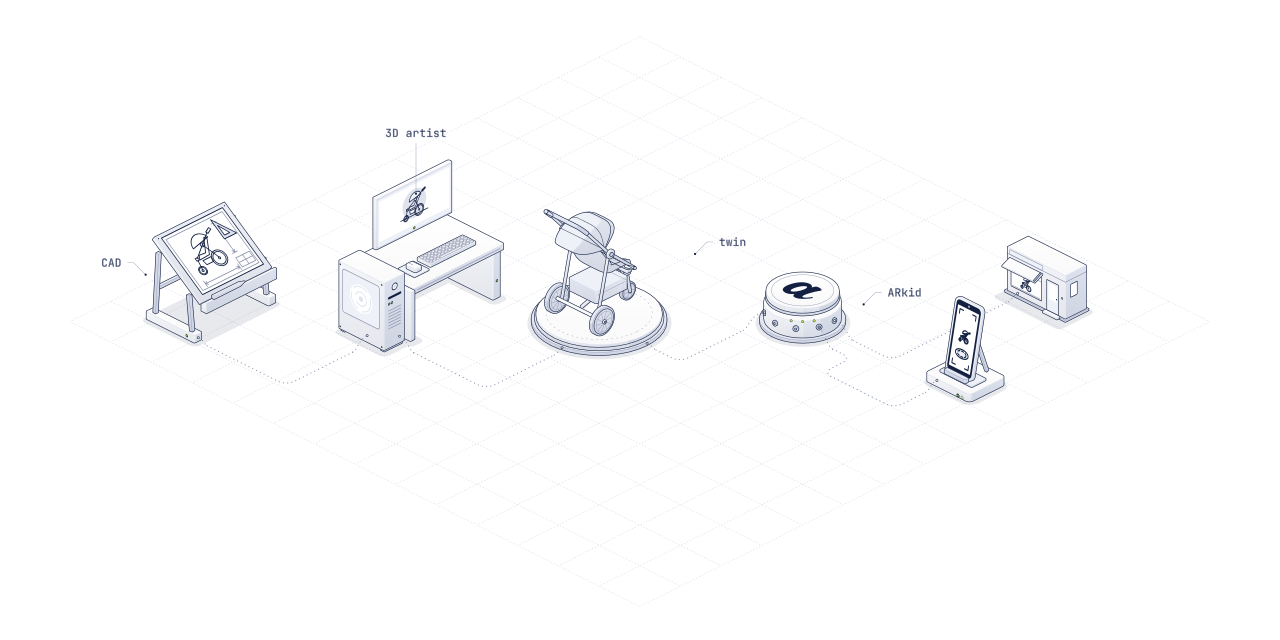
One twin. Every stage from concept to the shop floor.
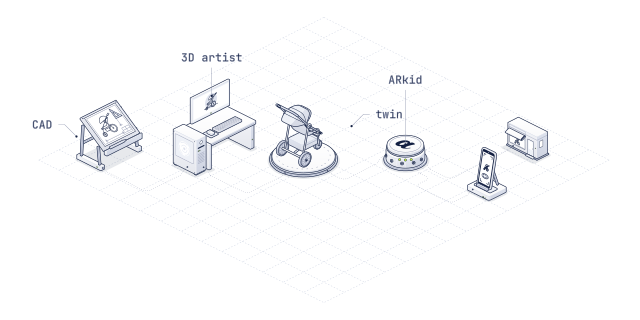
The simple story first: ARkid Studio produces the authorised model, it lives in ARkid Catalogue, and every channel uses it. Then the full 3D pipeline: seven stages from new product development (NPD) to In-Store.
Four steps. Then it keeps earning.
One investment, continuous payoff. A hero twin takes 4–8 weeks, 4 on a fast track. Every asset after that takes hours and days, because every channel draws on the same signed-off model.
- 01 · Walk-through
Brief us
Product, timeline, use cases. Walk-through-driven, not deck-driven: Studio scopes the twin and the channels it has to serve.
- 02 · ARkid Studio
Studio produces the twin
Hero-quality 3D from CAD, prototypes or references. Colourways, hotspots and WebAR scale, signed off by the brand rather than guessed by a third party.
- 03 · ARkid Catalogue
It lives in Catalogue
The model is listed once, with rights, variants and analytics. Authorised retailers embed it on their product pages. Explore the Catalogue
- 04 · Every channel
Every channel uses it
Viewer, AR, configurator, Sales View, in-store QR codes and imagery from ARkid Creator, the AI virtual photo studio: the same asset, no re-modelling.
From NPD to In-Store.
ARkid covers the seven stages your product passes through, concept to consumer, with one digital twin doing the work of every isolated tool you used to license separately.
- Stage 01 / 07
NPD
StudioConcept-stage twins, months before tooling is cut.
New product development: 3D twins de-risk design decisions and speed up review cycles long before the first physical sample exists. Engineering, marketing and sales work from the same source of truth.
How Studio supports NPD - Stage 02 / 07
B2B Marketing
Studio · CatalogueTrade material built from the twin, not the sample.
3D renders, video and AR replace flat product photography in retailer-facing material, months earlier than physical samples allow, with every variant and colourway available from day one.
The brand case - Stage 03 / 07
B2B Sales
CatalogueSales View turns the twin into a buying-meeting tool.
The same twin becomes an interactive, accurate sales surface in the field. No print collateral, no sample logistics: the product, configured live in front of the buyer.
Sales View in Catalogue - Stage 04 / 07
B2C Marketing
CreatorLifestyle, social and 360° from one twin.
Campaign imagery, social cuts and 360° videos generated from the same asset. Every variant, every channel, every market, without re-shooting a single product.
How Creator works - Stage 05 / 07
DTC Product Visualisation
Catalogue · CreatorBrand-owned channels, brand-owned perception.
Interactive 3D and WebAR on the brand’s own site reach markets that physical retail can’t serve economically, and put the full product story back in the brand’s hands.
DTC perception - Stage 06 / 07
Online
CatalogueOne line of HTML on the retailer’s PDP.
Configurators and AR previews embed directly into the retailer’s existing stack: no custom engineering, no bespoke integration, the same authorised asset in every shop.
3D & AR online - Stage 07 / 07
In-Store
In-StoreTouchscreens, signage and trade fairs from the same twin.
Touchscreen modules, QR shelf talkers, signage-ready output and trade-fair booths, all powered by the twin that feeds every other stage of the pipeline.
In-Store modules
Three roles, the same twin.
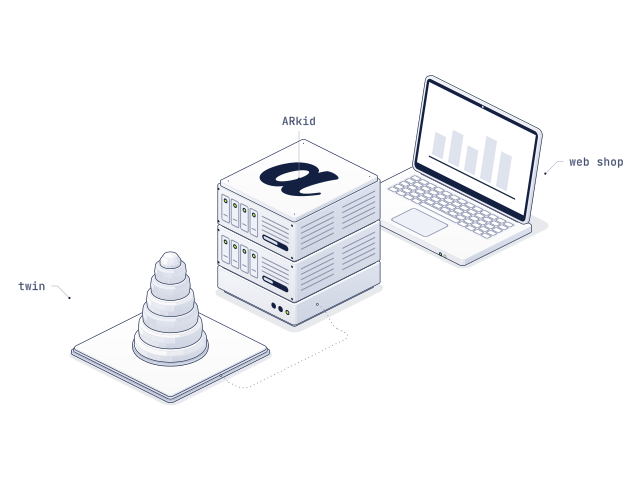
Each role works from the same signed-off twin: one model, approved once by the brand, used unchanged all the way to the consumer.
 Brand
Brands list their 3D models.
Authorised models from the manufacturer itself: one source, every channel.
For brands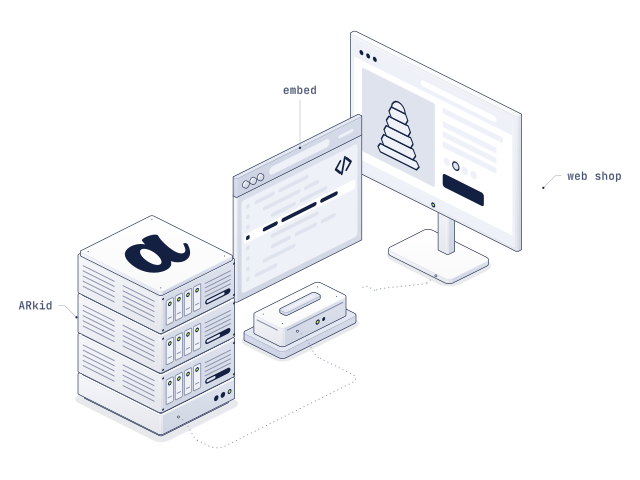 Retailer
s embed them in one line of HTML.
Interactive 3D, AR viewers, configurators and Sales View, with no engineering work required.
For retailers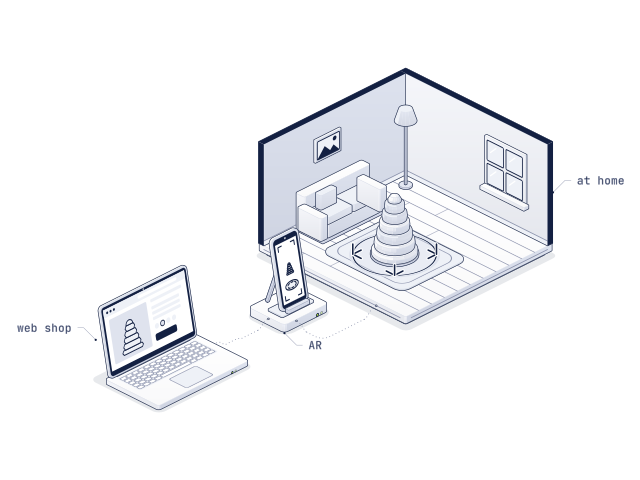 Consumer
s experience the product in their own room.
Web-based AR, no app to install. Dimensions, colours and harness systems, inspected before they buy.
For consumers
Distributors and trade agents work on the same rails: they walk into a buyer meeting with the portfolio already live, and their accounts carry no view fees.
For distributorsFour outcomes the category needs.
Each defensible with industry data and observable in ARkid’s own client base in baby and juvenile products.
- 01
Stand out
Interactive product representation sets a brand apart from competitors still relying on static pack shots.
- 02
Increase sales
Better understood products convert better. Hotspots, configurators and AR lift product memorisation and confidence to buy.
- 03
Reduce returns
Up to ~22% fewer returns documented in comparable furniture and homeware categories, driven by better pre-purchase understanding; the figure varies by product, category and baseline.
The consumer-side case - 04
Optimise inventory
The infinite aisle: present every colour and variant in store without carrying each one in stock.
Practitioner questions, briefly answered.
Is there an app to install?
No. ARkid is web-based. Configurators, 3D viewers and AR all run in the browser, so consumers don’t download anything to inspect a stroller in their own room.
Where is the data hosted?
In the EU. ARkid Catalogue runs in a German data centre, GDPR by design, with a standard data processing agreement (DPA) attached to every contract.
Do retailers need engineering work to embed?
No. One line of HTML, or a QR code in store. The embed is PDP-, PIM- and CMS-neutral, with no SDK required for typical retailer use cases. Integrations for Shopify, Shopware, Magento and others are available: see Integrations.
Where do the 3D models come from?
From the brand. ARkid is the authorised source: brands list their own twins or have ARkid Studio produce them with the manufacturer, so every retailer and every consumer sees exactly the model the brand signed off. Not an AI guess, not a retailer’s reverse-engineering.
What does it cost?
ARkid Catalogue runs on fixed monthly plans, starting with a free account. Model production by ARkid Studio is a separate engagement, scoped per project. See Pricing.
Signed off once. Current everywhere.
Ready to put a product through the pipeline?
Tell us the product and the first channel that has to go live. We come back with a clear scope.